Häufig gestellte Fragen
Startseite – Akademie –Häufig gestellte Fragen
General Questions
A: Possible root causes and corresponding preventive measures are as follows:
- Inadequate moisture isolation: If the tooth surface is not thoroughly dried, the adhesive may become contaminated by moisture, leading to incomplete or failed curing. Ensure effective isolation by using cotton rolls or a saliva ejector to remove all water, saliva, and other contaminants from the tooth surface.
- Insufficient light exposure: Light-cured adhesives need sufficient intensity and exposure time. Position the curing light probe at a 45° angle from both occlusal/gingival and mesial/distal directions for full penetration. Intensity and time are inversely related. Typical clinical units range from 400–800 mW/cm². For EasyOrtho Orthodontic Adhesive, at 600 mW/cm², cure for 20 seconds—adjust proportionally for higher or lower intensities.
- Improper storage of the adhesive:This product should be stored at 10–30°C in a cool, dark place, and may tolerate brief exposure to temperatures between 0°C and 60°C during transport. Improper storage conditions can compromise curing performance. Always use adhesive within its expiration date and strictly follow the storage instructions provided in the product manual.
A: Common causes of bracket debonding and recommended countermeasures include:
- Incomplete cleaning of the tooth surface: Residual soft debris, plaque, or calculus on the enamel can impair adhesion and increase the risk of debonding. Thoroughly clean the tooth surface, removing any calculus, soft deposits, or other obstacles before bonding.
- Incorrect bracket positioning: Incorrect bracket positioning (too high or too low) increases debonding risk. Ensure precise placement and close tooth contact. For canine/posterior debonding, apply primer before re-bonding, or use a thicker adhesive layer initially without removing excess. These measures keep failure rates well below 10%.
A: Our product requires no primer, as its bond strength is clinically sufficient for bracket bonding — optimally balanced at 7.4–7.8 MPa. This level ensures brackets remain securely attached during treatment while allowing relatively easy debonding at the conclusion of therapy, helping to preserve enamel integrity. However, for buccal tubes with pronounced axial curvature (e.g., canine surfaces), the use of a primer may be considered to increase bond strength to 11–12 MPa for enhanced retention.
A: Follow these steps carefully:
Cleaning: Thoroughly clean the areas to be bonded prior to treatment. A slow-speed handpiece with a brush may be used for effective cleaning.
Etching: Complete etching is confirmed only when a chalky white, demineralized surface appears. If this does not occur after etching, repeat the step until achieved.
Tooth surface preparation: Apply the agent evenly, gently air-thin to a uniform film, and light-cure for 5 seconds.
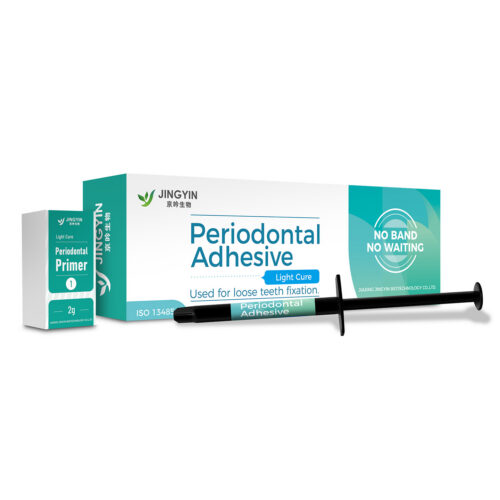
Material application: Inject Periodontal Adhesive into the interproximal spaces, then contour with an explorer as needed.
Light curing: Cure for 20–30 seconds. The adhesive should change from yellow-transparent to white-transparent. If no color change occurs, extend the curing time.
A: No. Physiological mobility falls within a range of 25–100 μm, which does not induce bone resorption; on the contrary, it supports bone formation. In the absence of physiological mobility, bone resorption may occur, potentially leading to stress shielding — a condition that adversely affects osteogenesis.
A:This product achieves optimal curing in a slightly moist dentin environment with minimal moisture present. A completely dry environment is actually less favorable for proper curing. Accordingly, when bonding to enamel, etch the enamel surface with etchant prior to applying Infinite Bond to allow moisture to escape from the tooth structure. For dentin bonding, etching may be omitted, or alternatively, lightly etch with our citric acid product and then air-dry before proceeding.
A:No. Infinite Bond is a self-curing adhesive that expands during polymerization, so it does not produce a tightening sensation. Due to its expansion property, it is particularly well-suited for use as a liner/base or restorative material in cavity fillings.
A:Anti-inflammatory treatment is recommended before applying Infinite Bond. Two options are available:
Irrigate with hydrogen peroxide and sodium hypochlorite, followed by laser irradiation, then alternate irrigation with sodium hypochlorite and saline to achieve thorough disinfection.
Expose the crack and cavity to blue light of a specific wavelength, causing bacterial plaque adherent to the crack and dentin to fluoresce red, clearly delineating the infected area. Then precisely remove all fluorescent infected tissue using appropriate instruments.